
Humanode Biweekly Vol. 116

Hi everyone,
Welcome to Humanode Biweekly Vol. 116, where we round up the latest across governance, ecosystem infrastructure, research, and long-form discussion.
This cycle, Vortex continued to move forward. Proto-Vortex Alpha v0.2 went live, bringing a stronger inVision dashboard and new mechanics that pushed the simulator closer to a more operational governance environment. In parallel, the latest dev logs focused on stabilization, proposal sync, system-state visibility, legitimacy, referendums, and stability monitoring.
The ecosystem also expanded with the launch of The Hub, a new partner product on Humanode that brought swapping, bridging, BioStaker, and pool creation into one place.
On the research side, the PoBU by theme series continued with new explainers on the threat model, measurable on-chain signals, and the limits of what the chain can show directly, followed by a recap of the series so far.
This cycle also brought several developments beyond core product updates.
We hosted a new Humanode Fireside with Steve Keen, centered on money creation, private debt, inflation, Bitcoin, and the wider logic of contemporary financial systems.
On the publishing side, we shared an essay, “When AI Agents Become ‘Users,’ Who Counts as a Person?”, which explored what is at stake when platforms begin classifying AI agents as users, and how that shift affects questions of personhood and participation online.
We also launched our Substack, opening a new space for longer-form reflections on identity, governance, privacy, and digital society.
The period concluded with the latest community-call recap, reflecting Vortex’s continued movement beyond its earlier testing phase and into a more developed stage.
With you,
— The Humanode Team
Vortex
Alpha v0.2 is live
A key development this cycle was the March 11 launch of Proto-Vortex Alpha v0.2. The update brought a more functional inVision dashboard, giving users a clearer view of system dynamics and governance conditions in real time. With the new release, Proto-Vortex moved further beyond an early simulation format and closer to an operational governance environment.
Dev Log #8 and #9
Dev Log #8 & #9 focused on alpha stabilization, including bug fixes, proposal sync, transition snapshots, and the release of a stability layer. The framing here was operational: getting the simulator more reliable under real use and making governance flows behave consistently in a live environment.
Dev Log #10
Dev Log #10 detailed the new mechanics behind the release: inVision as a live system-state dashboard, a Legitimacy mechanic driven by objections from active human nodes, a referendum flow when legitimacy collapses, and a Stability engine with thresholds and alerts.
Community Call Recap 8
We discussed major progress in proto-Vortex and suggested that the initial testing phase was approaching its end.
Community Call Recap Vol. 9
This Community Call was focused on current and future development, with the tone of a project moving further out of early testing and toward a more mature next phase.
Partnerships
The Hub launched on Humanode
This cycle also saw the launch of The Hub, a new partner product on Humanode that combined swapping, bridging, BioStaker, and pool creation in a single interface. The release added another practical layer to the ecosystem and made core DeFi functions easier to access.
Check it out here: https://thehub.town/
🗣 Humanode Fireside
Crypto talks a lot about macro. But most of CT still does not really study how money is created, how bank credit works, or why debt drives crises. That is why we invited Steve Keen.
If you do not know him: Steve Keen is one of the rare economists who saw the 2008 crisis coming for the right reason — the buildup of private debt and credit, not just “bad sentiment” or market noise.
One of the most important ideas from this conversation:
When a bank creates a loan, it also creates the money matching that loan.
If you miss that, you miss a huge part of how the modern economy actually works.
If we want to build new financial systems, programmable money, and better coordination mechanisms, we need to understand the system we are trying to replace, improve, or route around.
This is exactly why CT should know Steve Keen.
We talked about money creation, debt, crises, inflation, Bitcoin, and why crypto can become a lab for new monetary experiments.
Watch here: https://www.youtube.com/watch?v=YWdv51ZfjNo

PoBU by theme
What can go wrong in PoBU?
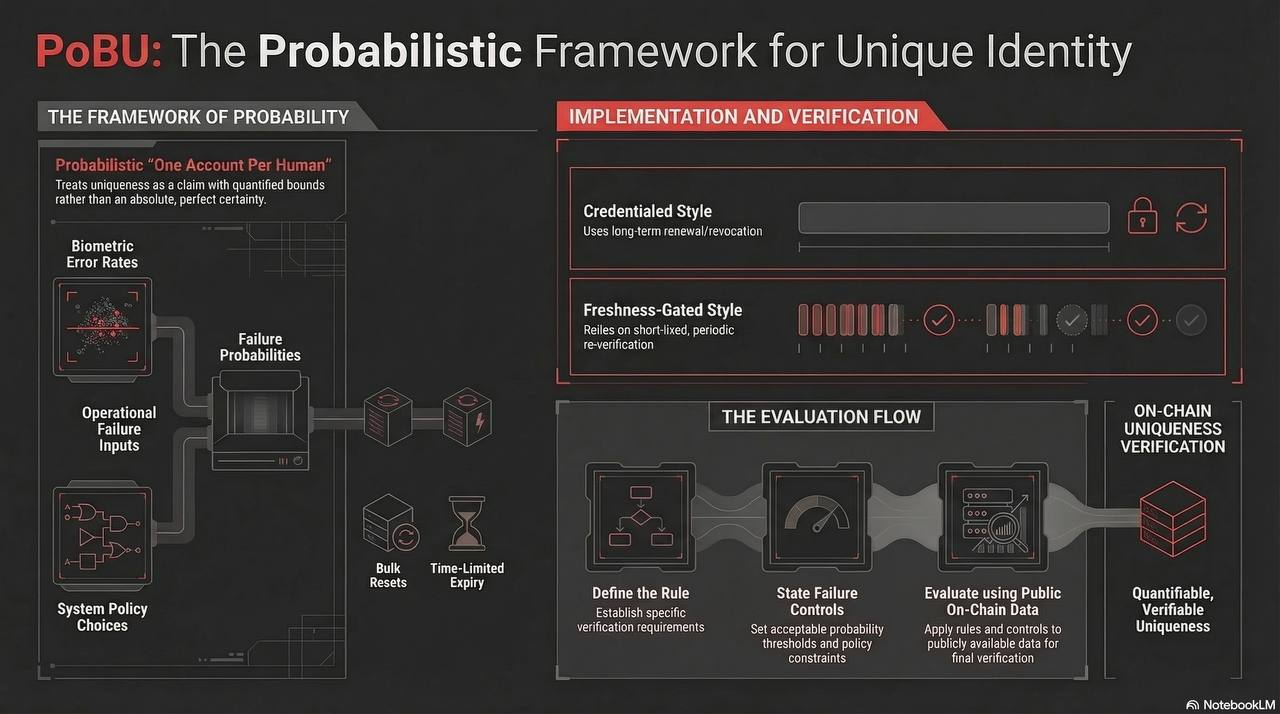
The cycle continued with a post on the PoBU threat model, asking a straightforward question: even if the “one eligible account per human” rule is clearly defined, what can still fail in practice? The piece laid out the main risk areas the PoBU paper tracks, including issuer concentration, compromise or coercion, availability, and privacy or linkability.

What can be measured on a running chain?
The next post moved from theory to observable signals. It focused on what can actually be measured on a live network through chain-derived indicators, including validator-set breadth and churn and block-author concentration. The point here was precision: PoBU is about unique humans, but on-chain observation mostly shows keys and network behavior, so the evaluation has to stay reproducible and modest about what it can claim.
What the chain can’t show yet
That limitation became the center of the next piece: “PoBU: What the chain can’t show (yet).” It stressed that some of the most important human-level properties remain outside direct on-chain visibility, even when on-chain data is useful for system assessment. The series kept the distinction clear between what the chain can surface and what still requires careful off-chain handling and interpretation.
Recap of the PoBU theme series
On March 19, we published a recap summarizing the six themes covered in the PoBU series so far. That post pulled the whole thread together in a more accessible way for readers who wanted the core ideas without reading the paper in full.
Publications and ecosystem thinking
When AI agents become “users,” who counts as a person?
We published Sasha Shilina’s article “When AI Agents Become ‘Users,’ Who Counts as a Person?” The piece takes recent platform language around AI agents as a starting point and pushes toward a deeper question about personhood, digital participation, and the political consequences of treating software agents as users.
MISC
Humanode on Substack
We had opened a Substack. The stated focus is longer-form writing on subjects that need more room: identity on the internet, Sybil resistance, governance, privacy, the structure of digital societies, and the limits of systems that measure participation through capital alone.
A feature on on-chain identity
On-chain identity is being recognized as one of the defining layers for scalable Web3. In CCN’s Top 101, the concept is explored through its role in governance, compliance, and access, with perspective from Humanode's co-founder Victor on how the root of trust evolves on-chain.
Take a look: https://www.ccn.com/top-101-in-crypto/on-chain-identity/

For more information, check out Humanode’s:
▲ Website
▲ GitHub
▲ Discord
▲ Youtube