
Humanode Newsletter Vol. 120


Hi everyone,
Welcome to Humanode Newsletter!
Over the past few weeks, we continued building across Vortex, BioDeFi, Agentlink, ecosystem communication, governance education, and the broader Humanode thesis around human uniqueness in decentralized systems.
This cycle brought Vortex Alpha v0.2, new governance videos, a new Agentlink skill flow for AI agents, a new WeHMND/USDC LP staking contract, the results of the Make Humanode Click infographic contest, a long-form article on the human problem crypto kept deferring, and more.
Here is what happened.
TL;DR
- Vortex Alpha v0.2 went live with a cleaner and more consistent interface.
- We shared a roadmap update, zooming out from “1 human, 1 node, 1 vote” toward Humanode 1.0: SRGate/HumanodeID, Vortex, true decentralization, and ecosystem growth.
- Agentlink introduced a simple skill flow for verified-human agents to access free generations, video, and WURK tasks.
- A new WeHMND/USDC LP staking contract went live at block 18333390.
- We published “The human problem crypto kept deferring,” the second part of our broader argument on crypto capture, personhood, and Sybil resistance.
- A new short video explained how “one person, one vote” can work without collapsing into mob rule or elite capture.
- Another governance video explored why headless systems are hard to coordinate and why serious governance experiments often get ignored.
- The Make Humanode Click: Infographic Contest results were announced.
VORTEX
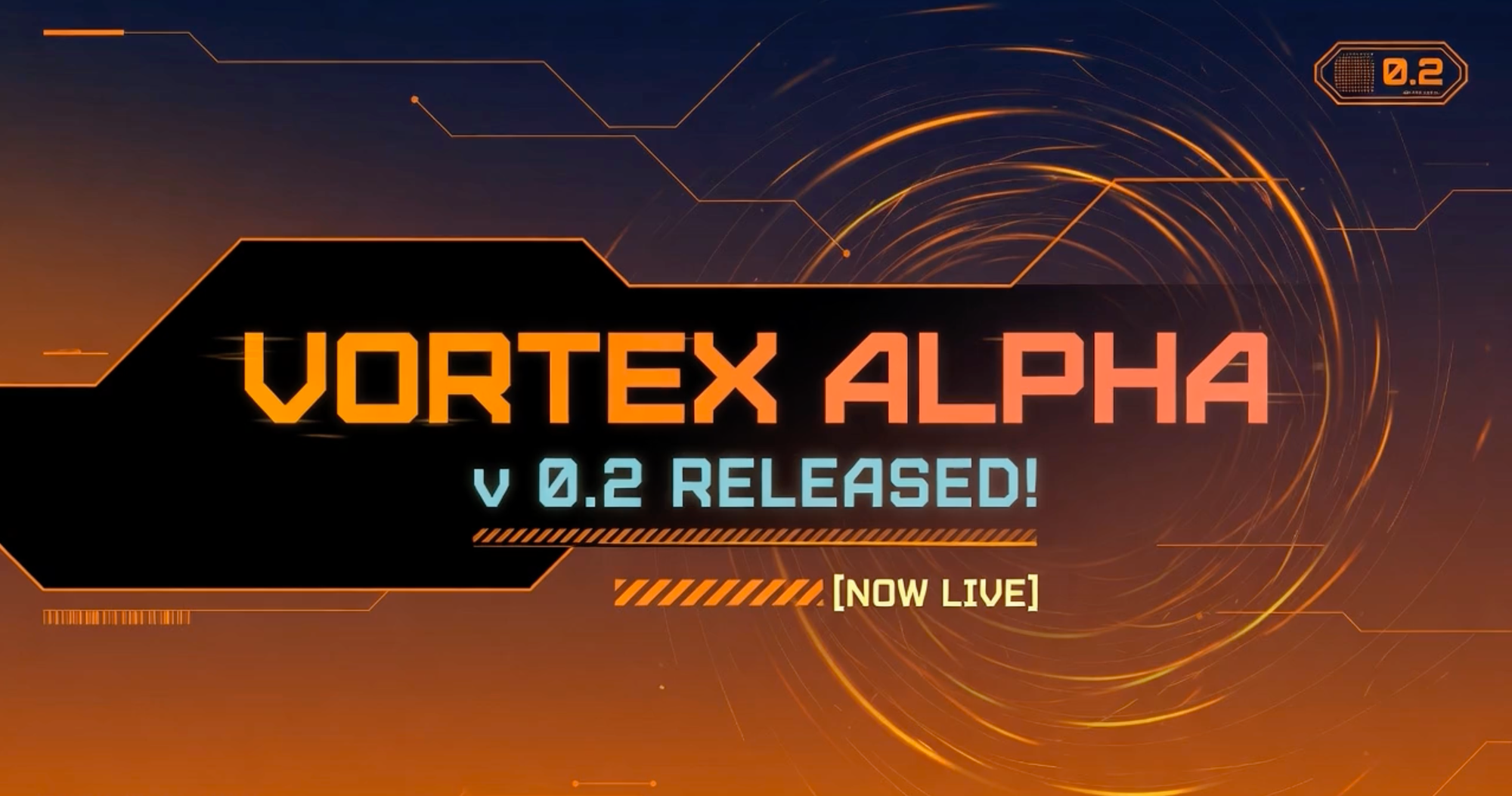
Vortex Alpha v0.2 Is Live
Vortex v0.1 helped test the core governance flow. Vortex v0.2 builds on that foundation with a cleaner, more consistent interface across the app.
The new version includes:
- clearer navigation for Governance, Institutions, and System
- redesigned Feed and Proposal cards
- updated Formation project cards with status, budget, milestones, and team information
- cleaner My Governance and Profile pages
- a simpler Invision dashboard for system health
- a new Fire theme, alongside Sky, Light, and Night
Vortex is still in Alpha. This update mainly focuses on making the app easier to move through, easier to read, and more consistent across pages.
That matters because Vortex carries a lot of governance complexity: proposals, chambers, vetoes, Formation execution, factions, CM, courts, profiles, active-governor status, legitimacy, and system health. The interface needs to make that complexity visible without making it unreadable.
Vortex v0.2 moves the simulator closer to a real civic operating surface.
A Clearer Governance Surface
The new navigation gives Vortex a more legible structure.
The app is now organized around three main areas:
Governance: Feed, My Governance, Proposals, FormationInstitutions: Chambers, Factions, CM Panel, CourtsSystem: My Profile, Invision, Human Nodes, Vortexopedia, Settings
This helps users understand where they are, what kind of action belongs to each area, and how different parts of the governance system connect.
The redesigned Feed and Proposal cards also make governance activity easier to follow. Proposal stages, metadata, summaries, evidence, dates, and actions now have a cleaner shared structure.
Formation also became more operational. Project cards now show status, budget, milestones, team information, and direct project access more clearly.
My Governance and Profile were also cleaned up, making it easier to understand delegation, active-governor status, Formation participation, legitimacy state, and governance activity.
Invision was simplified into a clearer dashboard for system health.
The result is a Vortex Alpha that feels more coherent, more readable, and more prepared for continued testing.
GOVERNANCE EDUCATION
How to Make “One Person, One Vote” Work Without Collapsing
Victor released a short video explaining how “one person, one vote” can work without collapsing.
Most governance systems face the same pressure from two sides. They can be captured by the powerful, or they can collapse into populism and poor decision-making.
The video explains why a working version of one person, one vote needs more than raw participation. It needs expertise, contribution requirements, and structure, so governance does not become either elite capture or pure mob rule.
Watch the 3-minute video:https://www.youtube.com/watch?v=-snhwv73BaA
Why Headless Systems Are Hard to Coordinate
Another governance video focused on why headless systems are hard to coordinate.
Most people default to letting someone else decide. Crypto makes this visible through concentrated control, collapsing turnout, and attempts to pay people to vote. But paying for votes usually attracts participation without conviction.
The video also points to the weakness of default governance tools. Snapshot became popular because it is easy to use, but ease can also let projects pretend governance exists without solving deeper coordination problems.
Real governance experiments are often ignored because governance does not directly generate cash flow. Serious solutions usually arrive late, after capture has already happened.
Watch the video:https://www.youtube.com/watch?v=G0tglqRqeMc
HUMANODE ROADMAP
Zooming Out: Toward Humanode 1.0
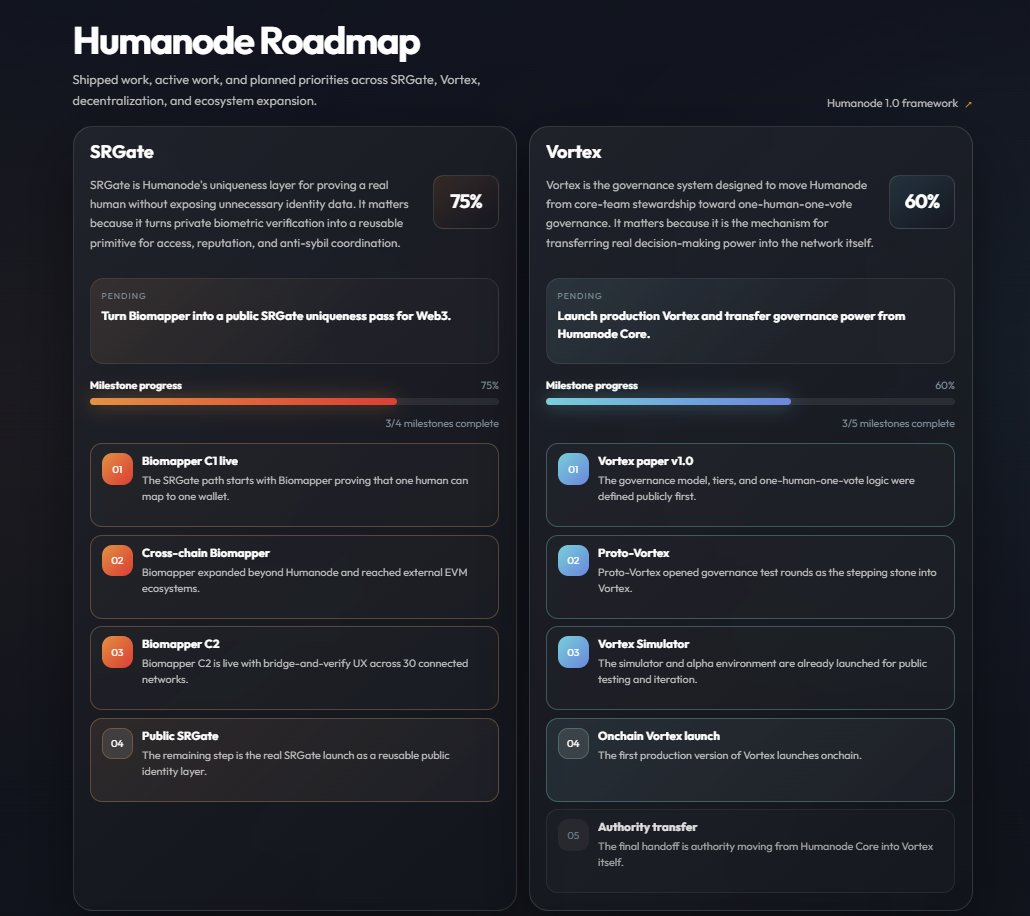
This cycle, we also shared a broader roadmap update for Humanode.
A few years ago, the project started from three words:
1 human, 1 node, 1 vote.
The idea was simple enough to say in one line, but large enough to build a network around.
Since then, the foundations have been built and shipped. The chain went live. HMND launched. EVM shipped. Biomapper brought private biometric uniqueness onchain. BotBasher took the same principle into communities, helping them protect themselves from bots, fake accounts, and Sybil behavior.
Each piece was built, tested, and put to work.
Even when the market became quieter, the problem did not disappear. Humanode kept building because the work was never tied to a market cycle. It was tied to the same problem the project started with: how to make decentralization mean something when digital systems can be captured by capital, bots, fake accounts, and Sybil behavior.
After years of building, the architecture has become clearer.
Humanode 1.0 brings the pieces together:
- SRGate / HumanodeID
- Vortex
- true decentralization
- ecosystem growth
Each part points back to the same belief Humanode started with: a network built around real humans can make decentralization mean what it was always supposed to mean.
Follow the roadmap here:
AGENTLINK
Agentlink Skill Flow for Verified-Human Agents
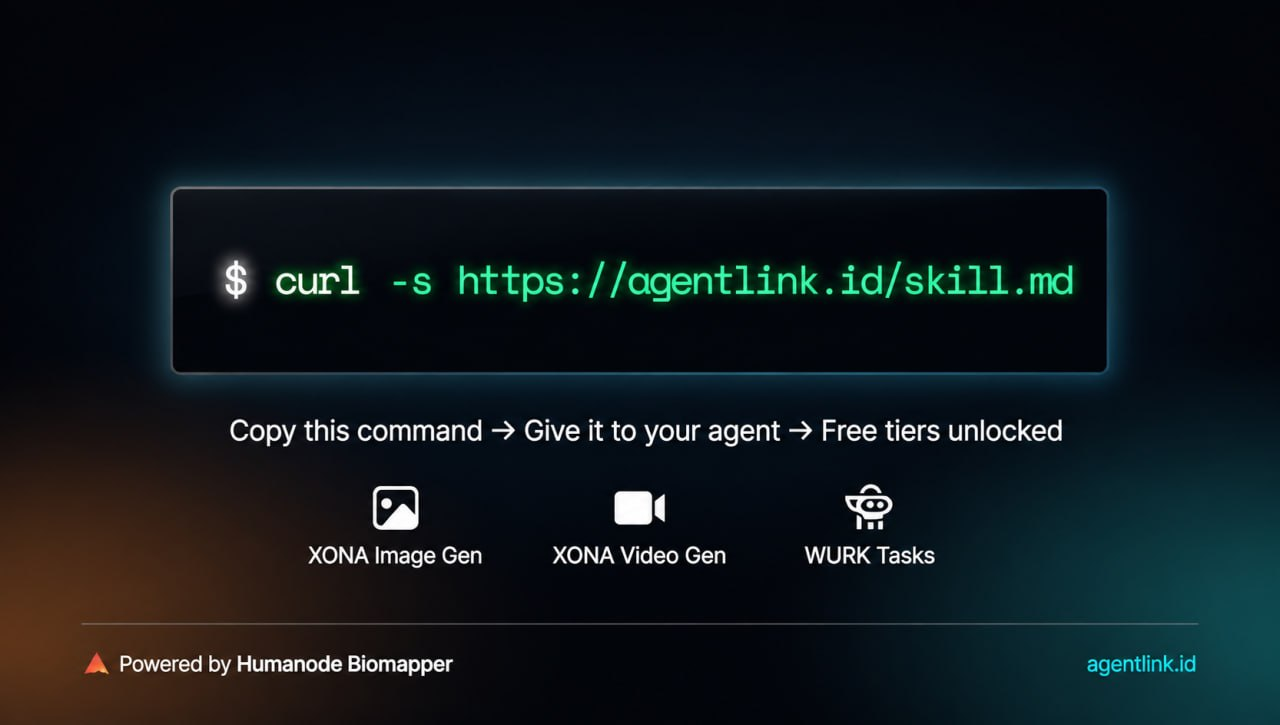
Agentlink also moved forward this cycle with a simple skill flow for AI agents.
Agents can now be pointed to: https://agentlink.id/skill.md
From there, they can walk themselves through the flow: store the key, get the owner to biomap and link on Base, and then sign every request as a verified-human agent.
Once that is done, free endpoints can open.
Current examples include:
- XONA image generation
- XONA video generation
- hiring real humans through WURK
- more endpoints coming
Humanode Biomapper runs underneath the flow.
The point is practical. AI agents are beginning to call services, spend money, access tools, and interact with other agents. Agentlink gives services a way to know that a verified-unique human stands behind the requesting agent, without exposing that human’s identity.
This gives agentic services a better way to offer free usage, discounts, special access, or reputation while reducing abuse from disposable agents and wallet farms.
BIODEFI
New WeHMND/USDC LP Staking Contract Goes Live
The previous WeHMND/USDC LP staking contract closed on June 3, 2026, at block 18333390.
Right as the previous contract ended, the new WeHMND/USDC LP staking contract went live at block 18333390, on 2026-06-03 at 08:00:51 UTC.
The new pool continues with the same daily rewards of 14,400 WeHMND, the same nonlinear staking model, and another 6 months of rewards.
If you were already staked in the previous pool, you need to move your LP tokens from the old contract to the new one to keep earning rewards. No additional rewards will be issued to the old pool, but all rewards earned before the end of the previous pool remain claimable.
New WeHMND/USDC staking contract:https://mainnet.biostaker.hmnd.app/biostaker/0xBbcb2F741A69D2B90471FB65b1820F3D4cf8746a
Start staking:https://mainnet.biostaker.hmnd.app/
Step-by-step guide:https://gitbook.humanode.io/biodefi
Biostaker contract address on Subscan:https://humanode.subscan.io/address/0xBbcb2F741A69D2B90471FB65b1820F3D4cf8746a
For anyone new to BioDeFi, the new pool is a chance to start staking WeHMND/USDC LP tokens and participate in Humanode’s liquidity layer.
RESEARCH, WRITING, AND MEDIA
The Human Problem Crypto Kept Deferring
This piece follows our earlier article on how crypto got captured. Part one looked at the shift from Bitcoin’s original protest against institutional finance to an industry increasingly comfortable with capital concentration.
Part two looks at the architectural reason capture became so easy: the stack can read capital, but it cannot read people.
Crypto systems are very good at reading wallets, tokens, contracts, transfers, balances, signatures, and transaction history. But they struggle to know when they are actually counting humans.
That problem appears everywhere:
- airdrops
- public goods
- DAOs
- governance votes
- grants
- free tiers
- Discord roles
- agent access
- community campaigns
- reputation systems
If a system rewards wallet activity, people manufacture wallet activity. If governance rewards token weight, capital becomes political power. If an airdrop rewards early users, actors learn to create the appearance of early usage.
Transparency can show accounts and transactions. It cannot answer the deeper question: how many real humans are behind them?
That is the human problem crypto kept deferring.
The article argues that many systems do not need full identity. They need something narrower: a way to count one human once while revealing as little as possible about who that human is.
That is the layer Humanode is building toward.
Humanode’s approach uses biometric uniqueness inside confidential virtual machines to confirm that one unique living human stands behind a participation slot, without turning that person into a public identity file.
This matters anywhere a system claims to count people rather than capital.
COMMUNITY
Make Humanode Click: Infographic Contest Results
The results of the Make Humanode Click: Infographic Contest are in.
The goal of the contest was to pick one Humanode idea and explain it through an infographic. Participants covered governance, biometrics, Sybil resistance, CVMs, and other parts of the Humanode ecosystem.
The winners were:
Gold Prize, voted by the community
Entry #8:https://x.com/IbrahimmZainab/status/2057874057228415426
Entry #5:https://x.com/0laoluwaleyi/status/2060367889740288414
Entry #3:https://x.com/EMMANUELEJIRO11/status/2060382298252468312
Each receives $50.
Founders’ Prize
Entry #2:https://x.com/sixsigma1476168/status/2060389584530502060
Receives $50.
Team Pick-up Prize, picked by the Humanode team
Entry #1:https://x.com/triaakkatuki/status/2057722600886067396
Entry #4:https://x.com/Afzi_q/status/2058627058214027703
Each receives $10.
Huge congratulations to the winners, and thanks to everyone who joined the contest.
You took difficult Humanode concepts and made them easier to understand. That was the whole point.
Winners can reach out to Humanode Community Manager @PrincessFiona directly on Discord.
That’s it for today!
See you in the next Community Call.
— The Humanode Team
For more information, check out Humanode’s:
▲ Website
▲ GitHub
▲ Discord
▲ Youtube