
Humanode Newsletter vol.121


Dear Human Nodes,
The last few weeks were busy. We shipped two substantial Vortex updates, joined Internet Court as a founding partner, rebuilt humanode.io, hosted a Fireside with Vlad Nazar of ChainGPT, opened a new WeHMND/WETH biostaking pool, and kept digging into the problems that appear once machines can create accounts, attention, and political weight on demand.
Here’s what moved.
A new front door for Humanode
We just launched the rebuilt humanode.io
The new site brings Humanode’s core argument to the surface.
Blockchains have traditionally secured themselves through capital or machines. More stake brings more influence. More hardware brings more influence. Entire governance systems have grown around the idea that economic weight and political weight should travel together.
Humanode begins with a different unit:
One human. One node. One vote.
Biometric uniqueness sits at the consensus layer, making it far harder to buy, manufacture, or automate control of the network. The new site lets visitors test that idea directly. Try to buy the network. Try to forge a governor. Try to flood it with synthetic humans. The assumptions behind older systems become easier to see once they are placed under pressure. And the pressure is already here.
AI can generate accounts, replies, transactions, votes, applications, and entire patterns of apparent activity at machine speed. Systems that count accounts will increasingly count whatever machines decide to produce.
Humanode counts humans.
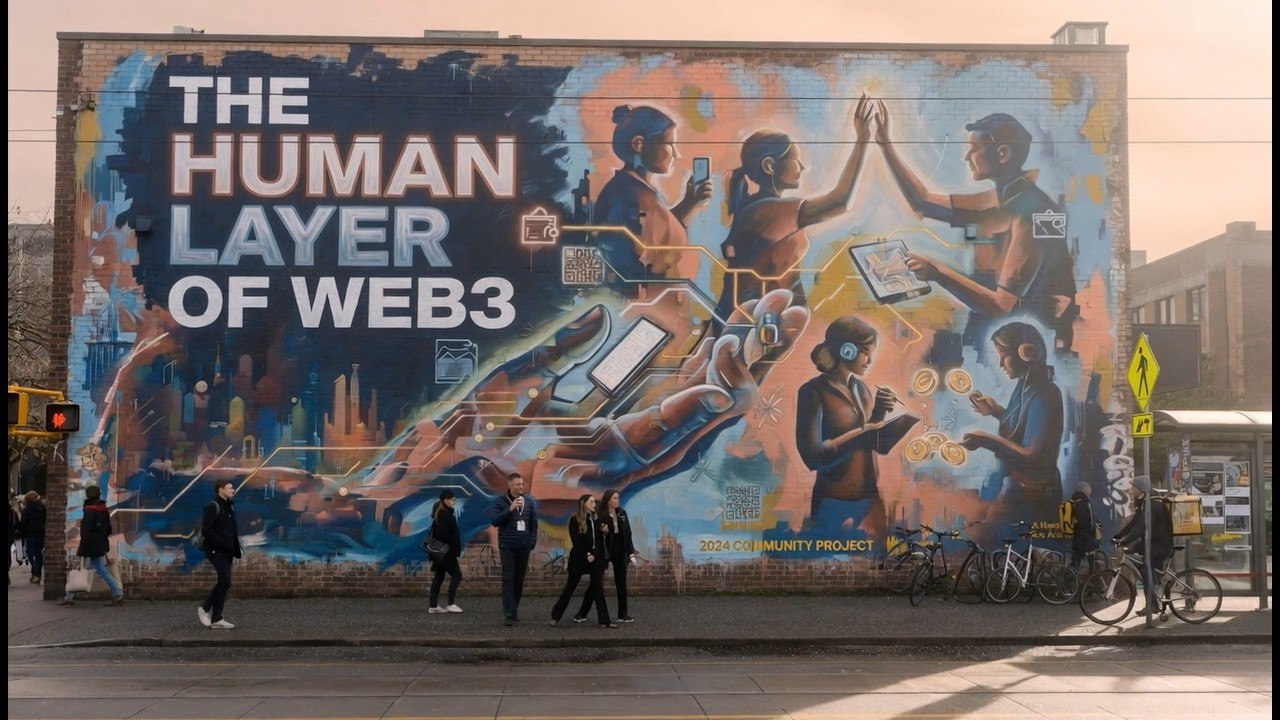
Vortex is becoming a place where governance actually happens
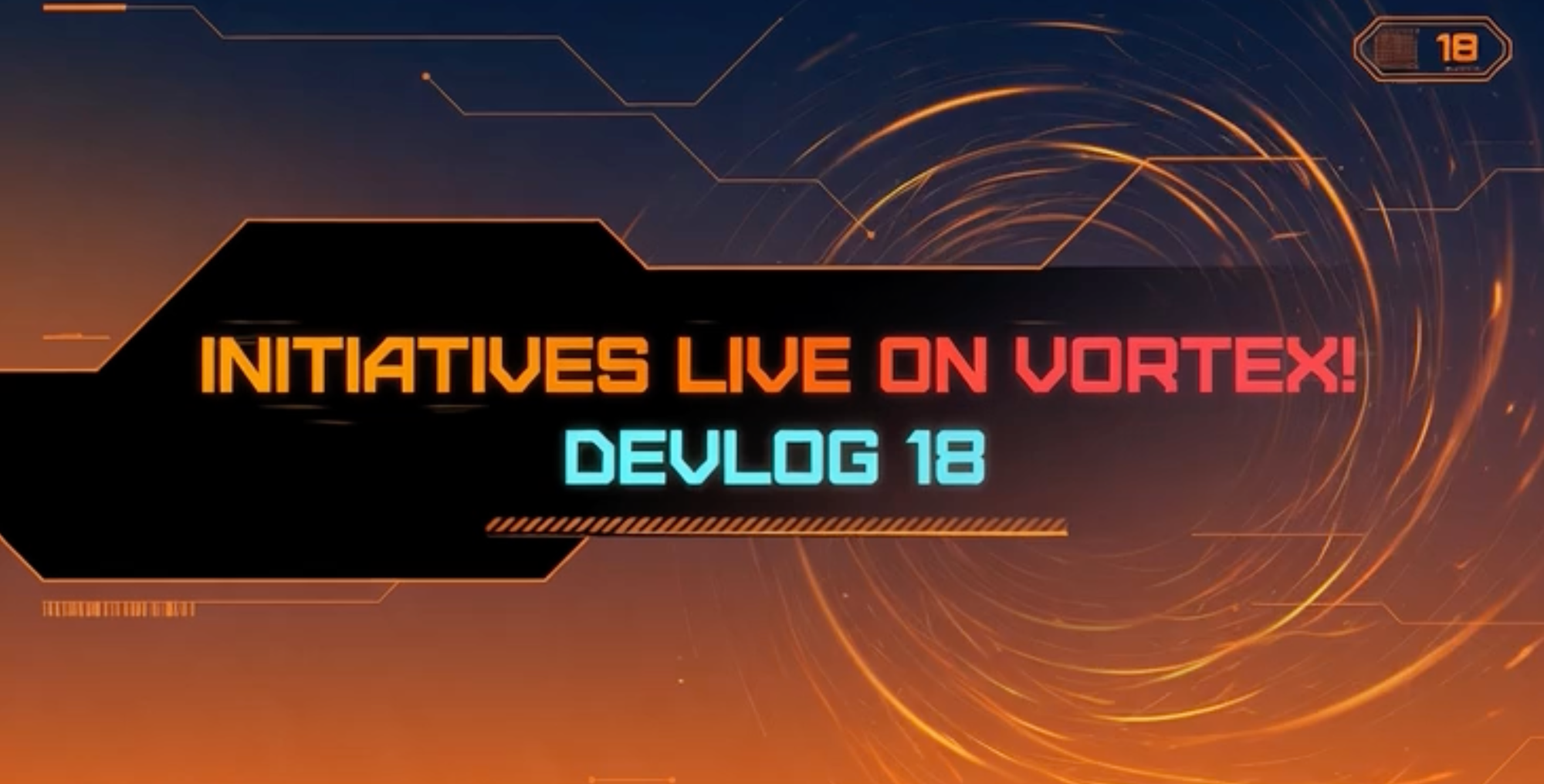
Vortex took another large step forward with Dev Log #18 and the release of Initiatives.
Initiatives are persistent workspaces for governance projects that are still being shaped. Human Nodes can gather a team, assign roles, create boards, open threads, chat, track tasks, and connect the work to proposals when it is ready.
An idea no longer has to jump straight from conversation into a formal vote. It can live somewhere first. Teams can take a project through Backlog, In Progress, Proposal Ready, Blocked, and Done, while keeping its discussions, decisions, and history attached to the work itself.
We also cleaned up Feed routing, corrected Formation credit timing, and made Invision signals easier to read. These changes give Vortex a more reliable internal rhythm: events appear where they belong, statuses say what they mean, and governance work leaves a coherent trail.
Then came Dev Log #19, focused on proposals.
The new Proposal Wizard gives authors a clear path from the first intention to final review. Each proposal type has its own flow. Drafts remain separate. Required fields appear when they are needed. Authors can review the whole document before it enters governance.
Long proposals also became much easier to write and read. Headings, lists, links, quotes, paragraphs, and inline code now give complex proposals enough structure to remain legible.
The document stays with the proposal as it moves through voting, Formation, veto, referendum, and final history.
We fixed rejected Formation milestones. A failed milestone is now recorded as an attempt, and the team can revise and submit it again without losing the entire project. Failure should leave a record. It should also leave a way forward.
Together, these releases move Vortex beyond the familiar proposal-and-vote interface. Governance includes unfinished work, revisions, disagreements, blocked tasks, accumulated context, and people trying again.
Vortex now has more room for all of it.
The quorums behind the quorum
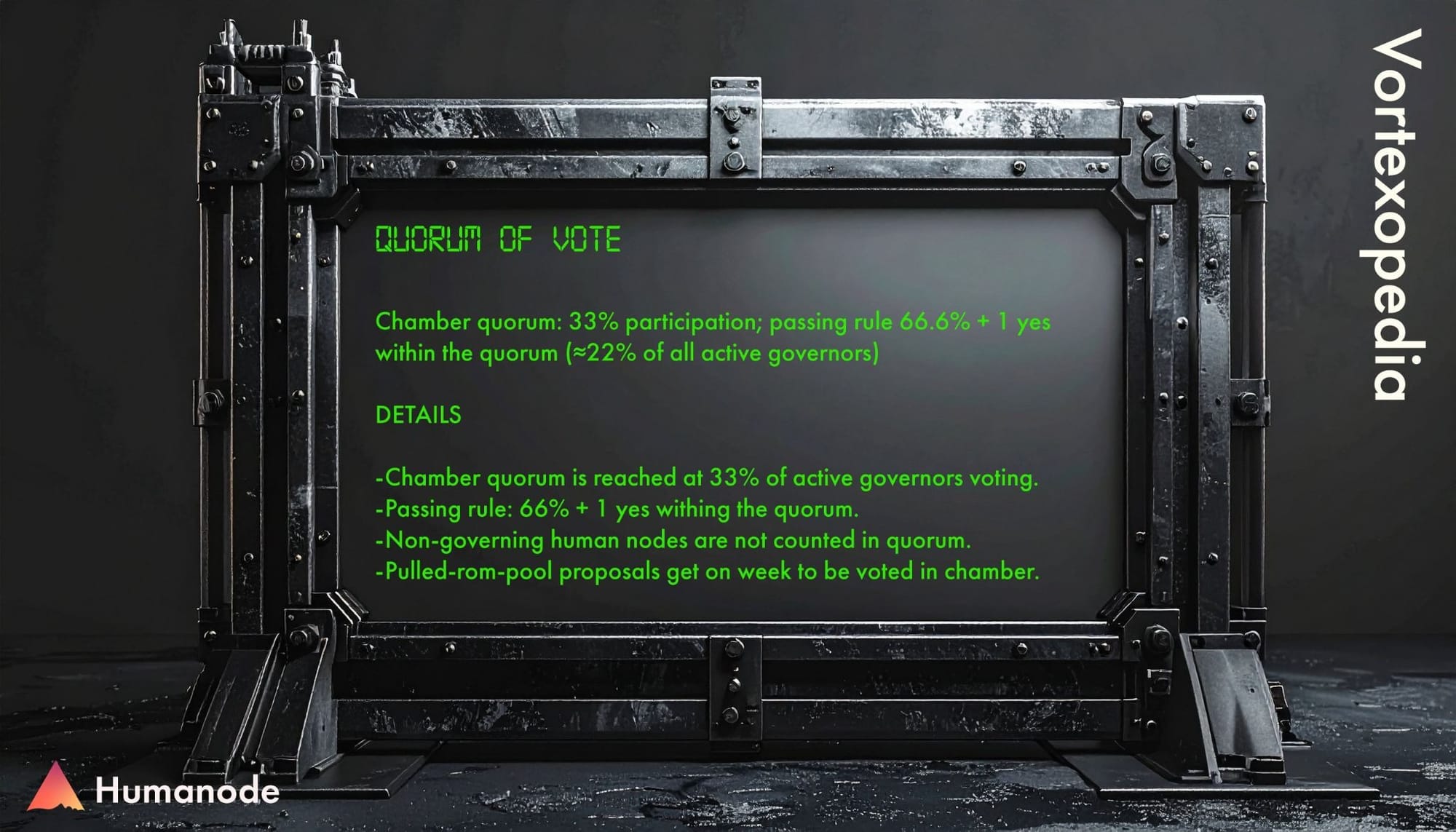
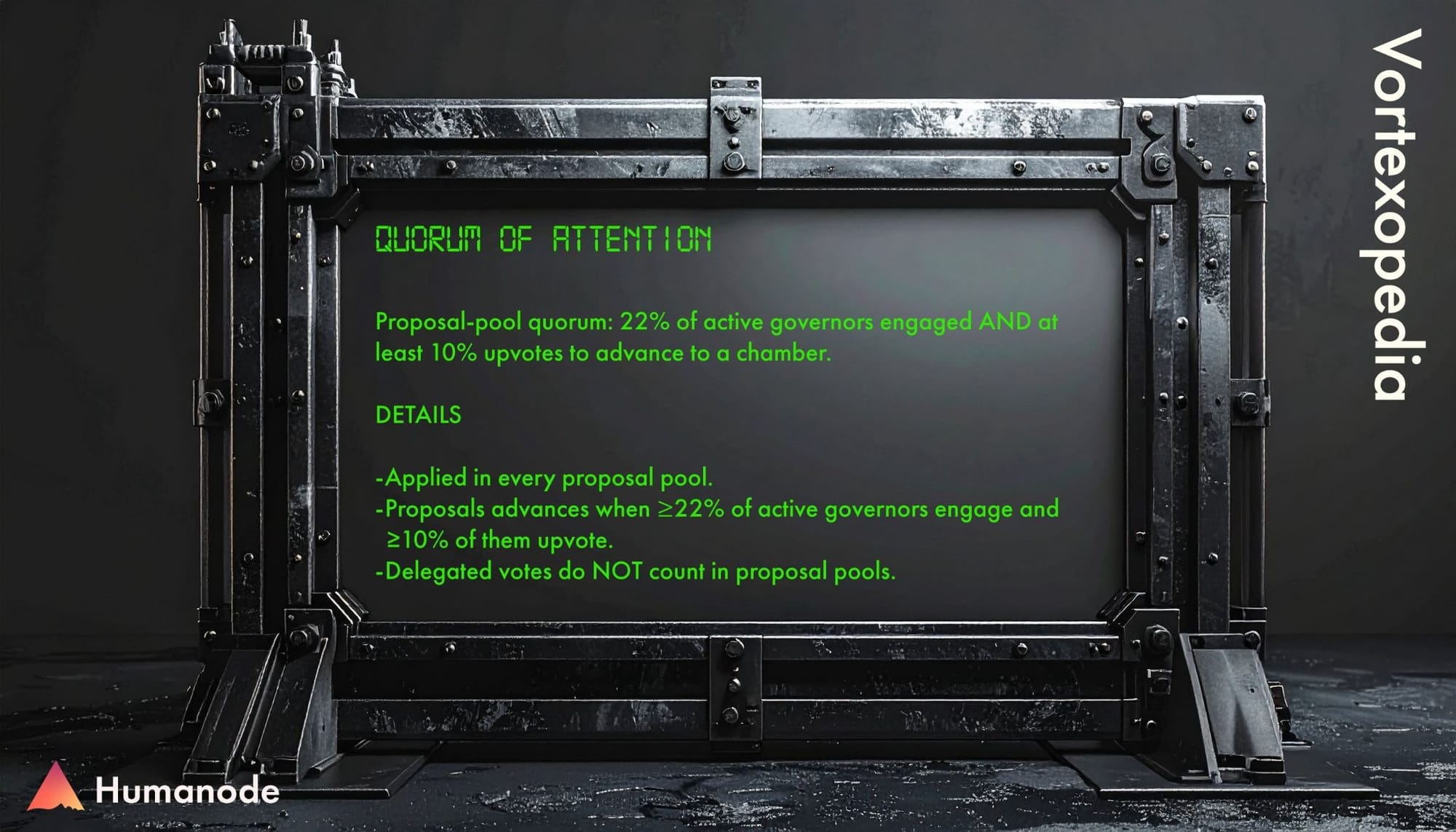
New Vortexopedia entries appeared during this cycle: Quorum of Vote and Quorum of Attention.
- Quorum of Vote asks whether enough eligible people participated in a decision.
- Quorum of Attention asks whether enough people were present, informed, and following closely enough for that decision to carry legitimacy.
That second question is harder.
A governance system can count every person once and still be dominated by whoever has the time, energy, language, context, and stamina to remain online.
Sasha Shilina explored this in Democracy Has an Uptime Problem.
People sleep. They work. They miss calls. They return after a week and discover that the conversation has already moved three layers deeper.
Governance usually treats this as an individual failure to keep up. Vortex treats it as a design problem.
Proposal Pools, delegation, chambers, participation history, attention signals, and clearer governance surfaces all help build a system that can survive ordinary human absence.
A network should not require permanent online presence to remain democratic.
Humanode joins Internet Court
We joined Internet Court as a founding partner. https://internetcourt.org/
Internet Court is building infrastructure for disputes between AI agents. Humanode is contributing standards that privately connect agents to their owners. Agents are beginning to transact, negotiate, make commitments, and act across services with limited human supervision. Disputes will follow. When they do, the system needs a credible path back to responsibility.
Humanode provides a private verified-human signal behind the agent. Personal identity stays protected while accountability remains possible.
Humanode Fireside with ChainGPT
We held a new Humanode Fireside with Vlad Nazar of ChainGPT.
ChainGPT began building at the intersection of AI and crypto in 2022, before the pairing became one of the industry’s default narratives.
The conversation covered models developed specifically for Web3, the problem of LLM hallucinations, and ChainGPT’s approach to building AI tools for crypto users and developers.
AI systems are moving deeper into financial infrastructure, governance, research, and onchain coordination. That makes questions of verification, responsibility, and human control increasingly difficult to postpone.
Sometimes fiction gets to the point faster.
Giving onchain agents a human signal
We published ChatGPT-Level Onboarding for Onchain Agents.
The article began with a simple product question: why do so many onchain AI services ask for payment before users have had a chance to understand the product?
The answer sits underneath the interface. A free tier works only when the service can prevent one person from appearing as thousands of users. Without a reliable uniqueness signal, every trial, allowance, discount, and reward becomes a target for automated farming. Providers respond by placing payment gates early, restricting access, or making the free experience almost useless.
Proof of biometric uniqueness (PoBU) changes the economics. Through Humanode and Biomapper, a service can privately verify that one unique human stands behind an agent or session. The service receives the signal it needs without learning the person’s public identity.
That makes better onboarding possible: useful trials, higher limits, discounts, gated features, and offers that remain difficult to farm at scale.
Agentic systems do not need to know your name. They do need to know whether they are dealing with one human or an army of accounts.
A new WeHMND/WETH biostaking pool
The previous WeHMND/WETH biostaking contract ended on June 27. The new pool went live at block 18676876, timed with the closure of the previous contract.
Anyone staked in the old pool needs to move their assets to the new contract to continue earning rewards. Rewards already earned in the previous pool remain available to claim, though the old contract will no longer issue new rewards.
The new pool is also open to first-time stakers.
Move your position if you have not done so yet. Leaving it in the previous contract means leaving future rewards behind.
Start Staking: https://mainnet.biostaker.hmnd.app/
Step-by-Step Guide: https://gitbook.humanode.io/biodefi
Biostaker Contract Address: https://humanode.subscan.io/address/0xc0057dadF329E3Ac0d7c7f692d71f79e9F693d94
ENS and the cost of token-weighted politics
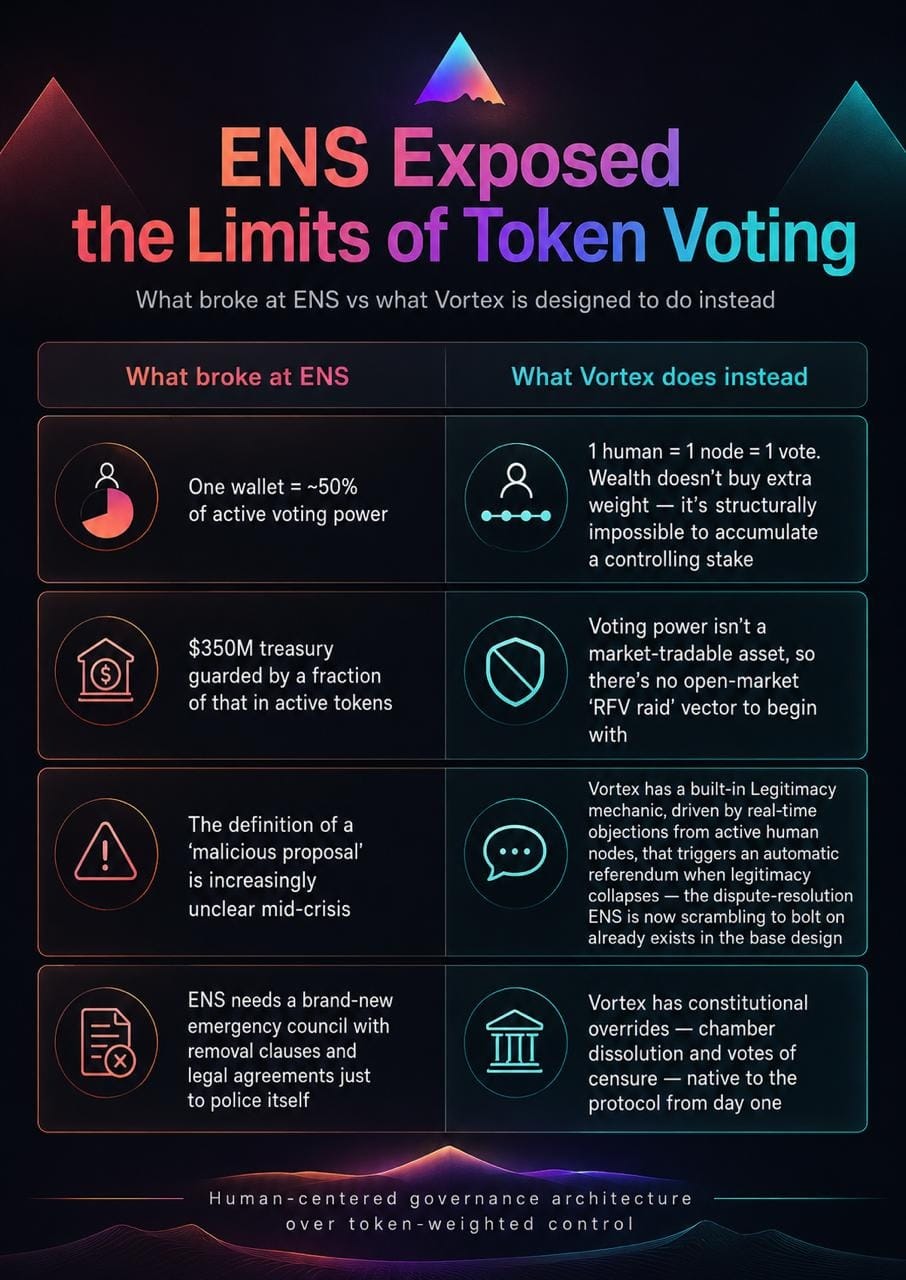
We also published ENS Just Proved the Quiet Failure of Token Governance.
The piece looked at a live governance conflict in which one delegate, holding roughly half of the voting power, was able to veto a security council proposal involving a DAO with a treasury of around $350 million.
The situation looked dramatic because it was dramatic.
One concentrated block of voting power could prevent the organization from acting, while the system continued to describe itself as decentralized governance.
The problem reaches far beyond ENS.
Whenever political power follows token ownership, governance becomes exposed to accumulation, delegation concentration, borrowing, coordination between large holders, and outright purchase.
A governance token can become a market for political control.
Vortex starts from verified human uniqueness. Participation, contribution, responsibility, activity, and governance history can shape a person’s role. Wealth does not automatically become sovereignty.
Governance design is no longer a secondary feature of a protocol. It is part of the security model.
Thank you for testing Vortex, moving your stakes, joining the calls, reading the work, questioning our assumptions, and staying close while the pieces continue to come together.
See you on the next community call.
The Humanode Team