
ENS Just Proved the Quiet Failure of Token Governance

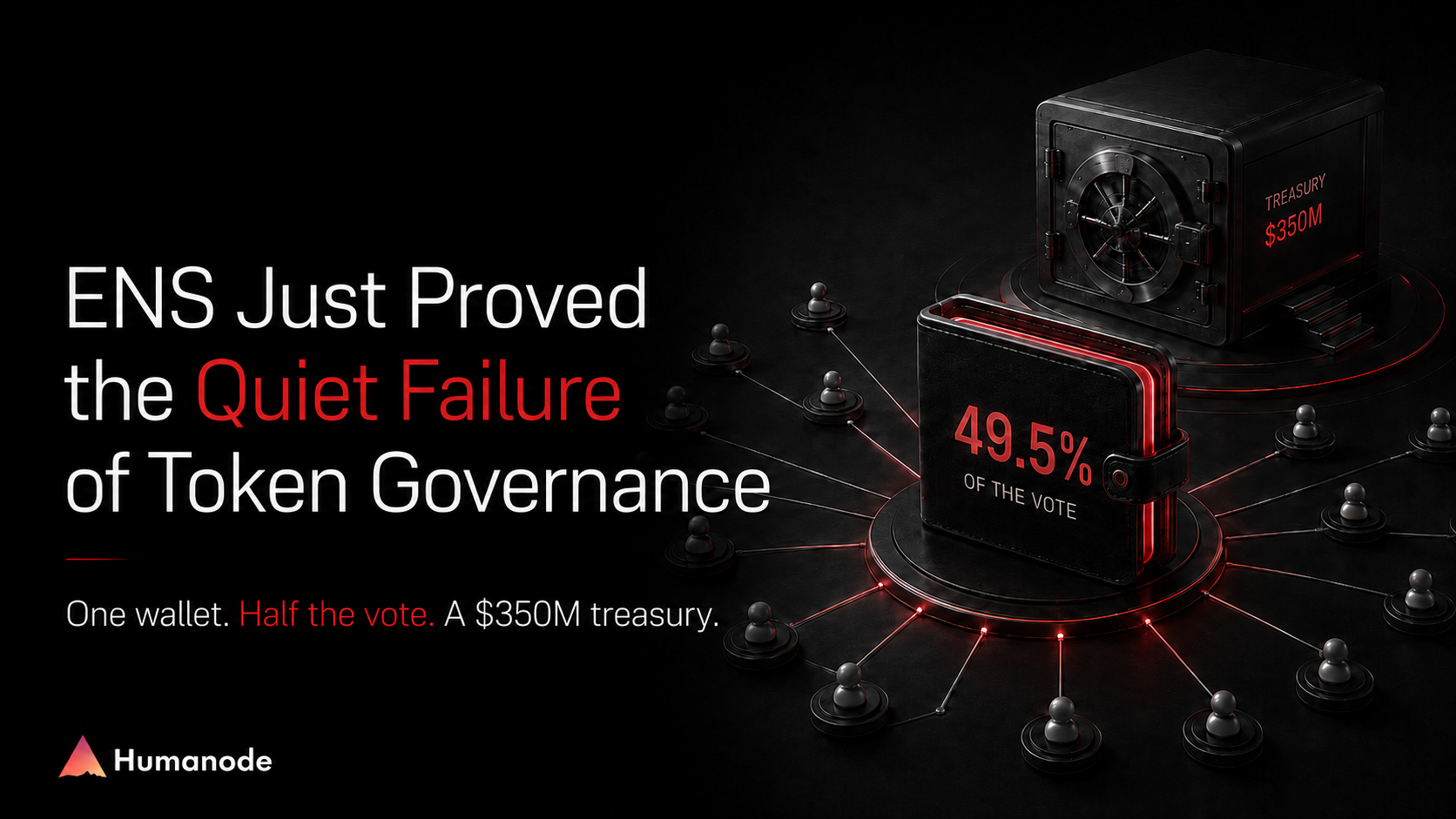
If you need a live, on-chain demo of why "decentralized governance" is often just a marketing term slapped on a plutocracy, watch one delegate with roughly 50% of the voting power veto a security council proposal and call it democracy.
The whole thing looks like drama from the outside, but what’s actually at stake is whether a DAO with a $350M treasury can make a binding decision when one wallet holds Veto power.
Welcome to the ENS DAO governance crisis. Let's break down what happened, why it's not actually an "ENS problem," and why Humanode was quietly building the exact fix for this two years before it became a headline.
TL;DR for the skimmers
- ENS was voting on whether to renew its existing Security Council, a 4-of-8 emergency multisig that can cancel malicious proposals before they execute.
- The renewal had passed the earlier Snapshot temperature check, but the binding on-chain vote failed after Nick Johnson voted against it.
- Johnson cast roughly 3.26 million ENS tokens, about half of active delegated voting power, pushing the “No” side to roughly 80%+ of votes cast.
- The decision did not transfer funds or change the treasury directly. It blocked the renewal of ENS’s main emergency veto layer.
- The current Security Council mandate expires on July 24, leaving ENS with limited time to approve a replacement.
- The larger issue is not one vote. It is that a DAO with a $350M treasury can have a critical safety decision decided by one highly concentrated voting position.
- Community members are openly calling ENS governance "dead," while others say Johnson's move was the only thing standing between the treasury and a hostile takeover.
What actually happened (two blowups, two weeks)
Blowup #1 – June 19: ENS Labs COO Katherine Wu dropped a proposal to shift day-to-day treasury, grants, and operational control from the DAO to the ENS Foundation, citing "delegate fatigue" and a DAO that was making too many small decisions and too few big ones.
The case for offloading daily operations was not absurd. Delegates get tired. DAO coordination takes time. As protocols grow, they need better ways to manage treasury, grants, operations, and execution. A DAO can still be useful for big decisions and overall legitimacy, but it is often not the best structure for everyday operational work, especially when even small decisions have to go through public governance.
The pushback was just as predictable and just as serious. Critics saw the proposal as a quiet transfer of power away from tokenholders and toward the Foundation. In their view, this was not operational cleanup. It was a soft centralization move where ENS would keep the language of DAO governance while moving real control somewhere else. That is why the discussion became heated so quickly. It touched the oldest tension in DAO design: who actually governs when execution becomes too complex for the crowd?
Blowup #2 – June 30: Katherine Wu also put forward a renewal of the DAO's Security Council, the 4-of-8 multisig with emergency power to cancel malicious proposals before they execute. It had already passed the informal Snapshot vote. Then the binding on-chain vote came around, and Johnson, who'd abstained the first time, showed up and voted no with a stack big enough to sink it alone. As of writing, the on-chain vote sits around **82% against renewal**, closing July 5, with the current council's authority lapsing July 24. That leaves the DAO racing the clock to stand up a replacement before July 24, when the current council's authority lapses and there's nothing left to stop a malicious proposal from going through.
Johnson's defense argument was that the members of the outgoing council had signaled they'd use their veto as political leverage, not as an emergency backstop, and he wasn't going to renew a council he didn't trust to stay in its lane. Karapetsas' read: Johnson just proved that one address can override the entire DAO whenever it wants, and called the governance process functionally dead.
Both things can be true. That's the point.
The math that should actually scare you
Here is the number that matters more than the drama: ENS controls a treasury worth hundreds of millions of dollars. Depending on what is counted and when it is valued, the public conversation has placed the number around the $350M to $500M range, with a much smaller but still serious amount in non-native assets. Once a DAO treasury reaches that size, governance stops being only a coordination process. It becomes a financial target.
This is the classic DAO honeypot problem. If the treasury is worth more than the practical cost of influencing governance, then the vote itself becomes the attack path. You do not need to hack the contracts, compromise the Foundation, or break the protocol. You can acquire, borrow, coordinate, or accumulate enough voting power, move through the process legally, and push the treasury in the direction you want. The system can fail while still behaving exactly according to its own rules.
That is what RFV raiders understand better than most governance idealists. RFV means redemption fund value, and the idea is brutally simple: if a DAO’s treasury is worth more than the market is pricing the governance token, then the token can become a route to the assets underneath. In plain English, buy the vote and extract the treasury. It does not look like an exploit in the traditional sense because the governance system itself is the mechanism being used.
This is not theoretical, and it is not specific to ENS. Gnosis DAO has been dealing with its own version of treasury redemption pressure, where governance becomes a channel for turning discounted DAO assets into a cash-out opportunity. Different DAO, same underlying exploit. When a treasury becomes large enough, capital concentration becomes a governance vulnerability, not just a market condition. The vote is no longer only a social process; it controls real assets.
The Security Council was ENS’s patch for this reality, but the current fight exposed the hole in the patch. Who decides what counts as malicious? Is a technically valid vote malicious if it threatens the treasury? Is a proposal malicious if it centralizes power but follows the process? Is a council protecting the DAO when it blocks a dangerous outcome, or is it overriding tokenholder governance because it dislikes the result? These are the central questions of token governance once the treasury becomes valuable enough to fight over.
ENS is now being forced to answer those questions in public.
This is a token-voting problem
Token-weighted governance was always going to end up here. It ties political power directly to capital, which means the wealthiest wallet whether that's a founder, a whale, or a "wealthy buyer" always has the loudest vote, no matter how the rest of the community feels. Low participation just makes it worse: Johnson didn't need 50%+1 of token holders; he needed 50%+1 of the tiny sliver that actually shows up to vote. This bug is the default state of basically every DAO running this model.
This is the contradiction token DAOs keep trying to manage. They want democratic legitimacy, but they allocate power through capital. They want community governance, but they depend on delegate concentration. They want decentralization, but they keep adding councils, foundations, multisigs, veto committees, and legal wrappers to protect themselves from the governance model they chose. None of those patches are automatically bad, but the pattern is revealing.
The more valuable the DAO becomes, the more token governance has to reintroduce trusted structures to defend itself from token governance. That is the quiet re-centralization curve. It does not happen because everyone suddenly stops believing in decentralization. It happens because the economic incentives outgrow the voting model, and the DAO has to choose between plutocratic capture and emergency centralization.
What Humanode's Vortex does differently
This is where it gets interesting for anyone who's been sleeping on Humanode. Humanode’s governance layer, Vortex, was built specifically to remove the mechanism that just broke ENS: capital-weighted voting power.
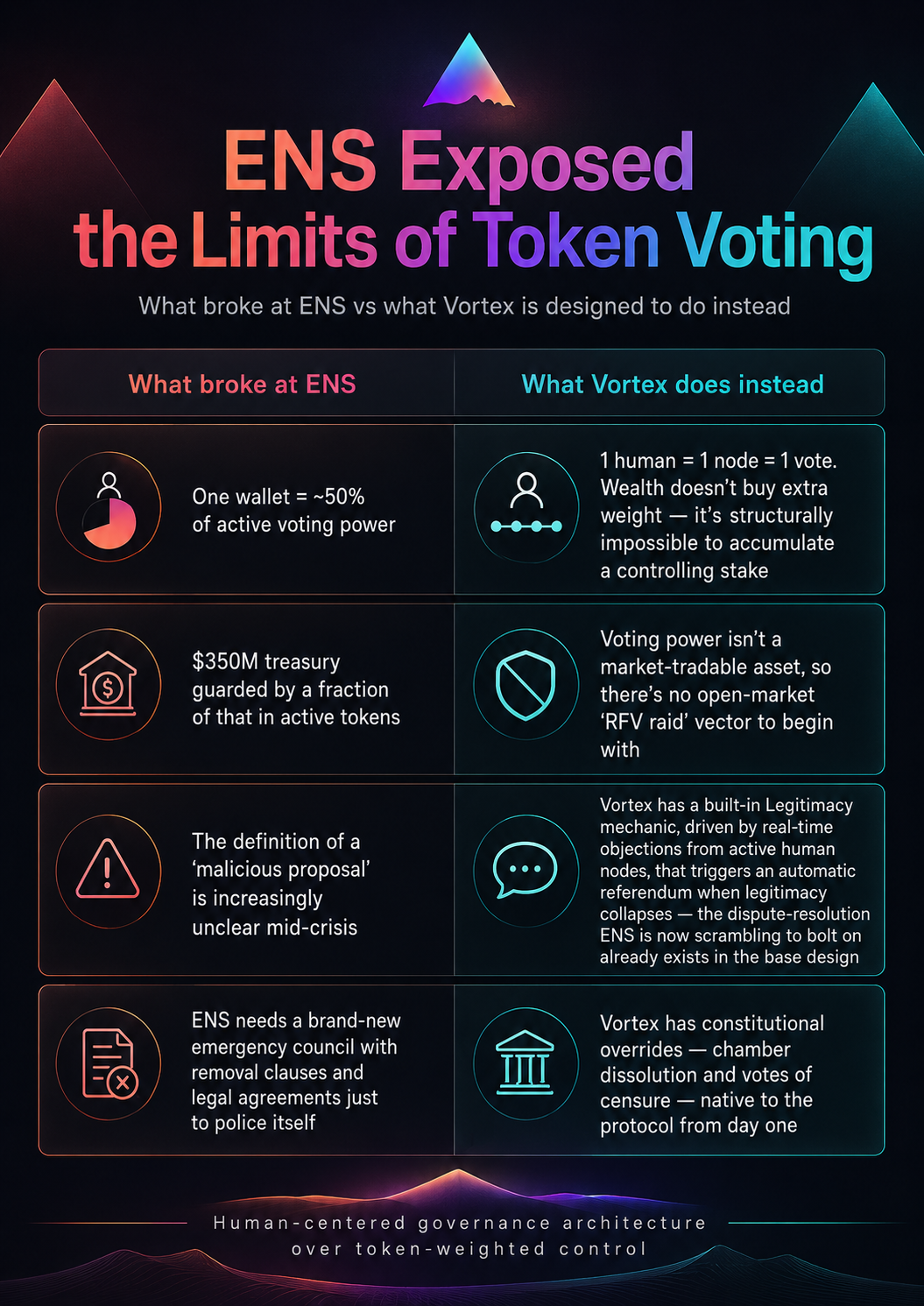
In other words: ENS is currently reverse-engineering, under crisis conditions, features that Vortex shipped as core architecture. Governance power in Vortex is earned through Proof-of-Time, Proof-of-Devotion, and Proof-of-Governance (activity and contribution, not bag size). Ranks unlock the ability to propose, not extra votes. No matter how big your position is, your ballot counts the same as the anon next to you.
Bottom line
The real takeaway: governance design is the product now, and degens who ignore that are the ones most exposed when the next vote gets bought.
ENS just gave the entire industry a very expensive, very public case study: when governance power is for sale, whoever has the biggest bag eventually *is* the DAO. Degens watching this play out should be asking the same question Humanode already answered: what happens to crypto governance the moment "one wallet, one vote" stops being the default?
Learn more about Vortex: https://whitepaper.humanode.io/whitepaper/governance-the-vortex-protocol
Try it now: https://51.15.66.138.nip.io/