Updates to the proto-Vortex flow

Each day, we learn something new, especially during the proof-of-concept phase of a project. After the first two rounds of proto-Vortex, the co-founders of Humanode got together to review the process and map out the changes needed to better reflect the actual flow of how Vortex is designed to work.
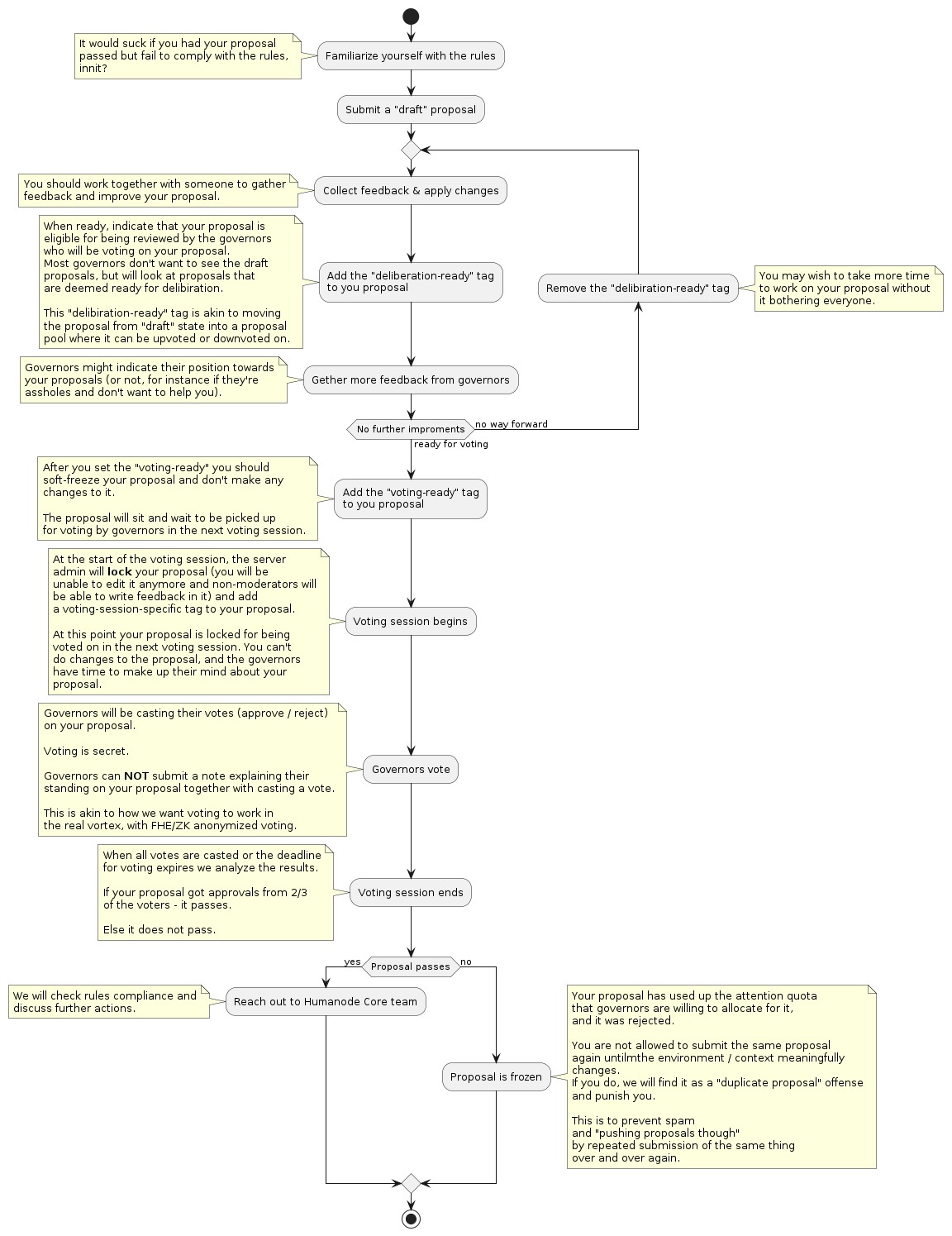
In a nutshell, we will be introducing three phases to the proposal process now.
Phase 1: Draft proposal. This is your initial proposal, which you will post to gather feedback in general. This is the phase in which you can gauge the general feeling the community has towards your proposal. Is it hot? Is it cold? Do you see a desire for your proposal to go through? Are people ignoring it or laughing out of their seats?
Phase 2: Give the draft proposal a “Deliberation Ready” tag. This is where the governors will step in and ask questions or indicate their position on your proposal. Once you gather the feedback, you may be ready to take the next step, or you may wish to take more time to work on the proposal, thus removing the “Deliberation Ready” tag and placing it back in the draft proposal pool until you have brushed up your proposal.
Phase 3: Add the “Voting-Ready” tag. This is when you will “soft-lock” your proposal and stop making changes. When the voting session comes around, the governors will “lock” your proposal, add a voting-session-specific tag to your proposal, and vote. If your proposals get approvals from ⅔ of the voters, the proposal passes. Anything under, and it does not.
It is important to note that if your proposal does not pass, it will be frozen, and you will not be able to make the same proposal again until there is a meaningful change in the environment or context. If you try spamming the same proposal to “push it through”, you will receive a “duplicate proposal” offense, and you will be penalized. Meaning that you will potentially lose proposal rights for a period of time.
One other fact that will be important to keep in mind is that although governors may interact with you during the draft phase or the deliberation phase, voting is done in secret. Governors can NOT submit a note explaining their standing on your proposal, together with casting a vote. This is akin to how we want voting to work in the real vortex, with FHE/ZK anonymized voting.
In simple terms, this means that each phase is quite important. You need to gauge the feeling during phase one. It might be important to work with someone during this phase in order to get meaningful feedback. The deliberation phase is also key. Governors who show interest in your proposal and ask questions are worth everything to you during this phase. Even if what they say seems harsh, or blunt, or even if they think your proposal is silly. You can use these voices as a sounding board and brush up on your proposal. No, you do not have to listen to everything they say, but even if a few governors do not agree with you, you may get a glimpse into what they hold value in, what types of proposals they are looking for, or how you can better explain why you feel your proposal will be important to the growth of Humanode.
And remember that once your proposal is set in stone for voting, various factors also come into play. Market conditions, timing, other projects, how much help you will need, the synergy with other projects or goals, etc. Just because a project does not pass, it is not the end of the world. Analyze the proposal and its journey, let it sit on ice until the moment arises when that proposal will shine, or take the info and your learning through the journey, and hatch another idea that you feel will work better.
As one final word of advice, the best products are most often the products that you know you would use, and that would make your life better or easier. “Nice to have” products are good, but they will never beat the “must have” products.
Shown below is the proposal flow chart for proto-Vortex. The general flow will be very close to how Vortex will work, so let's try this out. If adjustments are needed as we learn more through using this process, we will further refine the process.
In the meantime, happy proposals!