
When Your Game Economy Starts Lying to You

There’s a moment most game builders know but rarely talk about out loud. You launch an event, watch the economy tick up, and something feels off. Rewards get claimed too fast. Leaderboards look too clean, or worse, too strange. Your balance tweaks don’t move the needle the way they should. Something about your game’s heartbeat feels… wrong.
At first, you think it’s design. Maybe your rewards curve is off. Maybe you mispriced an in-game asset. Maybe your matchmaking algorithm needs a tweak. You spend hours on spreadsheets, dashboards, and attending internal standups. But deep down you feel it: this isn’t just sloppy balancing. These are Sybils. Multi-accounts. Alts. Whatever name you want to give them. And they don’t attack your game directly. They rot it from the inside.
This is where theory stops helping. Because Sybils don’t live in whitepapers. They live inside shipped games.
Ubiquitous enough that an industry survey found that 59% of gamers regularly encounter unauthorized bots in online games, and 71% say these bots damage multiplayer competition so much that nearly one in five players has abandoned a game because of it.
Some of this happens in the shadows. Modern fraud rings spin up dozens, hundreds, sometimes thousands of accounts to farm bonuses or exploit time-limited events. In other digital markets like online gambling, multi-accounting and bonus abuse are recognized problems precisely because they distort real engagement and reward systems.
And it’s not just about bots that kill or farm mobs in a corner. There are real cases in big titles. For example, PUBG reported that multi-account abuse was undermining the integrity of its ranked system, with players creating extra accounts to auto-level and later sell those accounts, or to repeatedly claim event rewards beyond fair limits.
Why does all of this matter so much? This matters because modern game economies are built on trust in participation. Liveops, in-game purchases, competitive ladders, and seasonal rewards depend on the assumption that activity maps to people. Global gaming revenue is projected to pass two hundred billion dollars, with a large share driven by repeat engagement and virtual goods. When even a small percentage of that activity comes from duplicated identities, the system bends in ways designers never intended.
The result is subtle. Inflation where there shouldn’t be. Scarcity where there should be excitement. Progression curves that feel stingy to honest players while being quietly harvested elsewhere. Communities sense it before analytics confirm it. Players describe games as “rigged,” “grindy,” or “unfair,” without ever seeing the invisible hands pulling value out of the system.
What Sybils actually do inside games
You might have thought bots and multi-accounts were peripheral, nuisances hidden in the margins. But that’s the quiet lie. They don’t lurk on the edges. They burrow into your game’s core.
Look at how Riot has been fighting this in VALORANT. In late 2025, Riot shared that around 40,000 bot accounts were banned over six months as part of efforts to improve fairness, especially in lower tiers where emerging players compete. That’s just the accounts they could confidently identify and remove, the ones clogging matchmaking and distorting competitive integrity.
In PUBG, multi-account abuse has been so pervasive that Krafton reported tens of thousands of accounts being banned every week for cheating or suspicious behavior, including alternate accounts created just to bypass ranked requirements or exploit event rewards.
Ask yourself how that looks from inside your economy. You launch a daily rewards loop or a week-long event, and systems that were meant to be pacing tools get emptied within minutes. Scripts grind bonuses, farming accounts stack rewards, and what was meant to be a slowly rising engagement curve becomes a jagged spike followed by a dead zone.
It doesn’t stop at rewards. PvP ladders fill with alts, shadow profiles that queue and requeue, manipulating matchmaking and leaving real players in tiers they never earned and don’t belong.
What does design do in response?
The hidden tax honest players pay
There is a tax inside every game that gets hit by multi-accounts and farms. Honest players pay it first. Studios pay it forever.
The player feels it as friction. More popups. More “verify your account.” More cooldowns. More hoops that have nothing to do with fun. The studio didn’t wake up wanting to do any of that. They wanted to ship content. They wanted to be generous and let the game breathe. But once the reward system starts leaking, the instinct changes. You stop designing for joy. You start designing for defense.
And the worst part is how quiet it is. Most of the time, you don’t see the farm. You just see the symptoms. Rewards “feel off.” Your economy inflates for no obvious reason. A weekend event gets burned down in hours. Your leaderboard looks like a photocopy of the same player name with different numbers at the end. Nobody reports it, because most people don’t even know what they’re looking at. They just know something feels unfair.
The farms are real, and the scale is not small. In late 2024, Nexon’s MapleStory Worlds team published ban data showing 1,679 accounts banned in two weeks for bot use, macroing, and similar behavior. Two weeks. One game ecosystem. That is not a rare edge case. That is routine maintenance now.
At some point, the relationship flips. The studio no longer designs with players. It designs around them. Suspicion replaces curiosity. Safety replaces experimentation.
Nobody celebrates this moment. It just happens.
Then you get the incentives that turn it into a business. In 2025, Epic sued a group accused of using thousands of bot accounts to manipulate engagement in Fortnite’s creator ecosystem and collect payouts, with the complaint pointing to activity across late 2024 into early 2025. That is the moment it stops being “kids cheating” and becomes industrial.
So the studio tightens everything. Rewards go down because they are being drained. Progression gets grindier because scripts chew through content faster than humans. Limited-time events become less generous because farms treat them like ATMs. Even customer support starts to change. Suspicion becomes the default setting. A real player loses access, gets flagged, gets stuck in a queue, and feels like the game doesn’t trust them anymore.
This is how studios slowly stop trusting their own players. So teams reach for tools. The ones everyone else is using. The ones that promise control. Each one adds friction. Each one buys a little time. None of them touches the actual problem.
And over time, the fix becomes heavier than the exploit.
Not because they hate them. Because the numbers lie. “Active users” who never talk, never churn, never care. Accounts that show perfect retention because they are automated. Engagement that looks healthy until you realize it is a loop, not a community.
And there is a bigger context here that makes it worse. Bots are not a niche problem on the internet anymore. Multiple reports in 2025 pointed out that automated traffic makes up a massive share of total web traffic, with reports that malicious bots alone represent a large chunk of it. Gaming doesn’t live outside that reality. It sits right in the middle of it.
You didn’t balance the game. You armored it.
Most studios don’t ignore Sybils. They fight them. Hard.
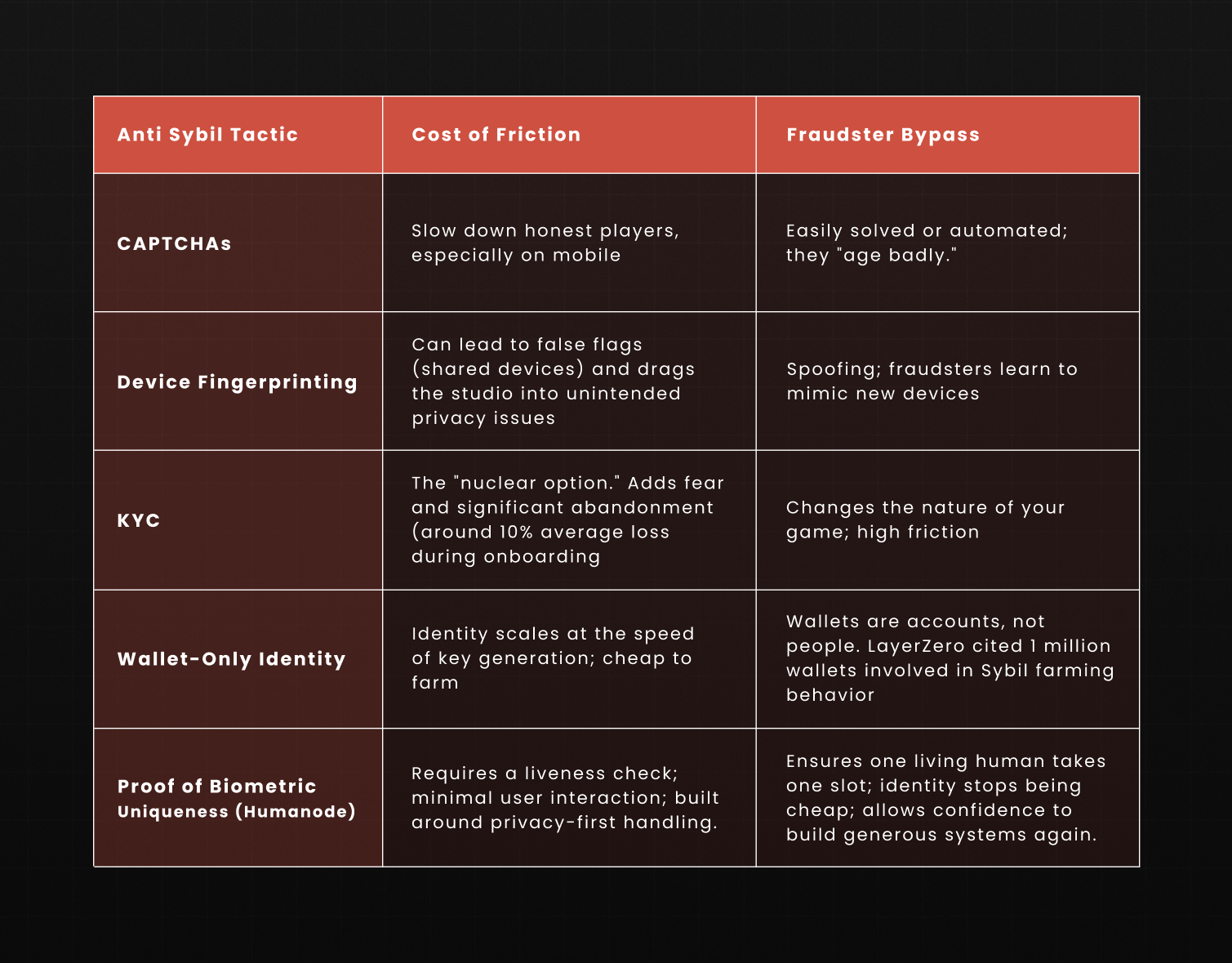
And the first tools people reach for are the ones that look “standard.” CAPTCHAs. Device fingerprinting. KYC. Wallet-based identity. They all feel like progress because they add a gate. But gates have a cost. And a lot of the time, the wrong people pay it.
CAPTCHAs are the obvious one. They slow down honest players, especially on mobile. They also age badly. As soon as a CAPTCHA becomes common, somebody builds a cheaper way around it. Even the industry is quietly moving away from the old “click the buses” era. Cloudflare built Turnstile largely because traditional CAPTCHAs are high-friction and leaky, and they’ve publicly positioned it as a “no CAPTCHA” alternative for many cases. And research keeps showing the same underlying truth: the more “human” the test is, the more annoying it becomes for humans, while automation keeps catching up.
Then comes device fingerprinting. It feels clean because the player doesn’t have to do anything. The system “just knows.” Until it doesn’t. Players change devices. Phones get shared. Cafes and schools sit behind the same network. And on the other side, the people who want to farm your game learn to spoof. Worse, fingerprinting tends to drag you into a privacy posture you didn’t ask for. It’s one of those techniques regulators and privacy folks keep circling because it can be used to track people in ways they can’t easily see or control.
KYC is the nuclear option. It can reduce certain kinds of abuse, sure. But it also changes what your game is. You don’t just add friction. You add fear. Fear of handing over documents, getting rejected, and being region-locked. And it hits conversion.
Even in mainstream financial onboarding, slow or heavy onboarding has been tied to meaningful abandonment and churn. One industry survey reported around 10% onboarding abandonment on average, and a large share of firms said they’ve lost customers due to slow onboarding. Games feel that pain faster, because games are impulse-driven. Players bounce for less.
Wallet-only identity is the quiet trap in Web3. It’s fast, familiar, and it’s also cheap to farm. If the unit of identity is “a wallet,” then identity scales at the speed of key generation. We’ve seen whole ecosystems publicly wrestling with this. In LayerZero’s own airdrop discourse, public reporting around the eligibility process cited that about 1 million wallets (out of roughly 6 million that had used the protocol) were involved in Sybil farming behavior. Even if that exact number shifts depending on definitions, the signal is loud: wallets are accounts, not people.
So the fixes pile up, and a strange thing happens. The game stops feeling generous. The UI gets suspicious. Rewards get stingier. Events get more restrictive. The studio starts designing around defense instead of delight. And players feel it.
There’s another way to think about this. Not as a gate or a punishment. As a structural assumption, you can finally rely on.
Because once identity stops being cheap, design stops being afraid.
When people hear “Sybil resistance,” they picture a bouncer. A gate. A hard stop.
What builders actually want is confidence that lets you be generous again.
Because once you can assume that one account equals one real human, the whole tone of your design changes. Daily rewards stop feeling like a liability. Events stop needing fifteen layers of anti-script duct tape. Progression can go back to being human-paced instead of “armored,” tuned around the idea that someone will brute-force your system by lunch.
And this is not some rare edge case. Valve publicly said it banned about 90,000 active smurf accounts in Dota 2 over “the last few months.” That’s one game, one category of identity abuse, one window of time.
Privacy-preserving Sybil resistance is where this gets interesting. Because it lets you raise certainty without turning your players into paperwork. You don’t need to know who someone is. You need to know they’re a unique person. After that, you can build as you trust them again.
This isn’t about adding a feature to a game. It’s about changing what the game can safely assume. About moving identity out of the application layer and into infrastructure, where it belongs.
That’s where Humanode enters the picture
Game studios keep trying to solve a human problem with account rules. And accounts are cheap. That’s the whole issue. If your “player” can be spun up in seconds, you end up designing for ghosts.
Humanode’s angle is uniqueness. Proof of Biometric Uniqueness (PoBU). One living human can take one slot.
Humanode tools like Biomapper, OAuth 2.0, and BotBasher take the same idea and make it usable as infrastructure. A one-time liveness check with your raw biometric data, not what gets shared or stored in the clear. The flow is built around encrypted processing and privacy-first handling, because nobody wants gaming to turn into KYC theatre.
Once the ground stops shifting under your feet, everything above it gets simpler. Numbers mean what they say. Systems behave like systems again. And trust starts creeping back in.
It’s also not “one chain only.” Biomapper is meant to be used across chains and products, so a studio can use it without rebuilding its whole stack. Similarly, OAuth 2.0 is meant to be used for products that aren’t on Blockchain yet.
Now, what changes for a studio when you have that kind of confidence?
One team already had to answer that question in practice.
Emeroth Studio’s Catacomb Crawlers went looking for that kind of confidence when they took their roguelike survival title into the Humanode ecosystem. The beta pulled in hundreds of thousands of curious players, over 240,000 downloads, and tens of thousands of daily active users crowding into a world built on looped runs and rewarded risk.
But the part that mattered most wasn’t the combat, or the loot tables, or the beauty of the pixel art. It was how they chose to protect the marketplace, the place where players trade gear, shards, from the same rot we’ve been talking about.
Humanode’s Biomapper becomes the quiet checkpoint at the edge of that economy: a brief verification before a player engages in asset trading, a scan that says this person is one human and nothing more is stored than the proof.
Catacomb Crawlers isn’t the only place this matters. But it’s one of the first games where the marketplace itself is protected by human-centric verification, where realness is woven into the economy rather than bolted on as a curious afterthought. That’s the kind of shift that changes how a studio thinks about progression, reward design, and community growth in a game built for people rather than scripts.
For you, this means your metrics start behaving again. The “we have X users” lie stops being a strategy. And if that sounds dramatic, go look at Roblox getting pressured over bot and alternate accounts inflating activity. Public markets do not enjoy guessing games about whether a “user” is a person or a script.
Economy design gets calmer. You stop building your game like a bank under siege. You stop punishing everyone because a farm is draining rewards. You stop shrinking generosity because you’re terrified of being exploited.
Community trust comes back in small ways first. Leaderboards feel less like a joke. Events last longer than a few minutes before the scripts finish them. Support doesn’t feel like an endless argument about “prove you’re you” while three alts are laughing in the background.
The close is quiet.
If Sybils disappeared tomorrow, what would you design differently?
What would you patch? What would you finally ship?
That’s probably the game you actually want to build.